The tale as the Brothers Grimm published it, in Margaret Hunt's classic English translation of 1884, unabridged. Note: in places the original is much harsher than our bedtime version.
Hans had served his master for seven years, so he said to him, “Master, my time is up; now I should be glad to go back home to my mother; give me my wages.” The master answered, “You have served me faithfully and honestly; as the service was so shall the reward be;” and he gave Hans a piece of gold as big as his head. Hans pulled his handkerchief out of his pocket, wrapped up the lump in it, put it on his shoulder, and set out on the way home.
As he went on, always putting one foot before the other, he saw a horseman trotting quickly and merrily by on a lively horse. “Ah!” said Hans quite loud, “what a fine thing it is to ride! There you sit as on a chair; you stumble over no stones, you save your shoes, and get on, you don’t know how.”
The rider, who had heard him, stopped and called out, “Hollo! Hans, why do you go on foot, then?”
“I must,” answered he, “for I have this lump to carry home; it is true that it is gold, but I cannot hold my head straight for it, and it hurts my shoulder.”
“I will tell you what,” said the rider, “we will exchange: I will give you my horse, and you can give me your lump.”
“With all my heart,” said Hans, “but I can tell you, you will have to crawl along with it.”
The rider got down, took the gold, and helped Hans up; then gave him the bridle tight in his hands and said, “If you want to go at a really good pace, you must click your tongue and call out, “Jup! Jup!”
Hans was heartily delighted as he sat upon the horse and rode away so bold and free. After a little while he thought that it ought to go faster, and he began to click with his tongue and call out, “Jup! Jup!” The horse put himself into a sharp trot, and before Hans knew where he was, he was thrown off and lying in a ditch which separated the field from the highway. The horse would have gone off too if it had not been stopped by a countryman, who was coming along the road and driving a cow before him.
Hans got his limbs together and stood up on his legs again, but he was vexed, and said to the countryman, “It is a poor joke, this riding, especially when one gets hold of a mare like this, that kicks and throws one off, so that one has a chance of breaking one’s neck. Never again will I mount it. Now I like your cow, for one can walk quietly behind her, and have, over and above, one’s milk, butter and cheese every day without fail. What would I not give to have such a cow.” “Well,” said the countryman, “if it would give you so much pleasure, I do not mind giving the cow for the horse.” Hans agreed with the greatest delight; the countryman jumped upon the horse, and rode quickly away.
Hans drove his cow quietly before him, and thought over his lucky bargain. “If only I have a morsel of bread—and that can hardly fail me—I can eat butter and cheese with it as often as I like; if I am thirsty, I can milk my cow and drink the milk. Good heart, what more can I want?”
When he came to an inn he made a halt, and in his great content ate up what he had with him—his dinner and supper—and all he had, and with his last few farthings had half a glass of beer. Then he drove his cow onwards along the road to his mother’s village.
As it drew nearer mid-day, the heat was more oppressive, and Hans found himself upon a moor which it took about an hour to cross. He felt it very hot and his tongue clave to the roof of his mouth with thirst. “I can find a cure for this,” thought Hans; “I will milk the cow now and refresh myself with the milk.” He tied her to a withered tree, and as he had no pail he put his leather cap underneath; but try as he would, not a drop of milk came. And as he set himself to work in a clumsy way, the impatient beast at last gave him such a blow on his head with its hind foot, that he fell on the ground, and for a long time could not think where he was.
By good fortune a butcher just then came along the road with a wheel-barrow, in which lay a young pig. “What sort of a trick is this?” cried he, and helped the good Hans up. Hans told him what had happened. The butcher gave him his flask and said, “Take a drink and refresh yourself. The cow will certainly give no milk, it is an old beast; at the best it is only fit for the plough, or for the butcher.” “Well, well,” said Hans, as he stroked his hair down on his head, “who would have thought it? Certainly it is a fine thing when one can kill a beast like that at home; what meat one has! But I do not care much for beef, it is not juicy enough for me. A young pig like that now is the thing to have, it tastes quite different; and then there are the sausages!”
“Hark ye, Hans,” said the butcher, “out of love for you I will exchange, and will let you have the pig for the cow.” “Heaven repay you for your kindness!” said Hans as he gave up the cow, whilst the pig was unbound from the barrow, and the cord by which it was tied was put in his hand.
Hans went on, and thought to himself how everything was going just as he wished; if he did meet with any vexation it was immediately set right. Presently there joined him a lad who was carrying a fine white goose under his arm. They said good morning to each other, and Hans began to tell of his good luck, and how he had always made such good bargains. The boy told him that he was taking the goose to a christening-feast. “Just lift her,” added he, and laid hold of her by the wings; “how heavy she is—she has been fattened up for the last eight weeks. Whoever has a bit of her when she is roasted will have to wipe the fat from both sides of his mouth.” “Yes,” said Hans, as he weighed her in one hand, “she is a good weight, but my pig is no bad one.”
Meanwhile the lad looked suspiciously from one side to the other, and shook his head. “Look here,” he said at length, “it may not be all right with your pig. In the village through which I passed, the Mayor himself had just had one stolen out of its sty. I fear—I fear that you have got hold of it there. They have sent out some people and it would be a bad business if they caught you with the pig; at the very least, you would be shut up in the dark hole.”
The good Hans was terrified. “Goodness!” he said, “help me out of this fix; you know more about this place than I do, take my pig and leave me your goose.” “I shall risk something at that game,” answered the lad, “but I will not be the cause of your getting into trouble.” So he took the cord in his hand, and drove away the pig quickly along a by-path.
The good Hans, free from care, went homewards with the goose under his arm. “When I think over it properly,” said he to himself, “I have even gained by the exchange; first there is the good roast-meat, then the quantity of fat which will drip from it, and which will give me dripping for my bread for a quarter of a year, and lastly the beautiful white feathers; I will have my pillow stuffed with them, and then indeed I shall go to sleep without rocking. How glad my mother will be!”
As he was going through the last village, there stood a scissors-grinder with his barrow; as his wheel whirred he sang—
“I sharpen scissors and quickly grind, My coat blows out in the wind behind.”
Hans stood still and looked at him; at last he spoke to him and said, “All’s well with you, as you are so merry with your grinding.” “Yes,” answered the scissors-grinder, “the trade has a golden foundation. A real grinder is a man who as often as he puts his hand into his pocket finds gold in it. But where did you buy that fine goose?”
“I did not buy it, but exchanged my pig for it.”
“And the pig?”
“That I got for a cow.”
“And the cow?”
“I took that instead of a horse.”
“And the horse?”
“For that I gave a lump of gold as big as my head.”
“And the gold?”
“Well, that was my wages for seven years’ service.”
“You have known how to look after yourself each time,” said the grinder. “If you can only get on so far as to hear the money jingle in your pocket whenever you stand up, you will have made your fortune.”
“How shall I manage that?” said Hans. “You must be a grinder, as I am; nothing particular is wanted for it but a grindstone, the rest finds itself. I have one here; it is certainly a little worn, but you need not give me anything for it but your goose; will you do it?”
“How can you ask?” answered Hans. “I shall be the luckiest fellow on earth; if I have money whenever I put my hand in my pocket, what need I trouble about any longer?” and he handed him the goose and received the grindstone in exchange. “Now,” said the grinder, as he took up an ordinary heavy stone that lay by him, “here is a strong stone for you into the bargain; you can hammer well upon it, and straighten your old nails. Take it with you and keep it carefully.”
Hans loaded himself with the stones, and went on with a contented heart; his eyes shone with joy. “I must have been born with a caul,” he cried; “everything I want happens to me just as if I were a Sunday-child.”
Meanwhile, as he had been on his legs since daybreak, he began to feel tired. Hunger also tormented him, for in his joy at the bargain by which he got the cow he had eaten up all his store of food at once. At last he could only go on with great trouble, and was forced to stop every minute; the stones, too, weighed him down dreadfully. Then he could not help thinking how nice it would be if he had not to carry them just then.
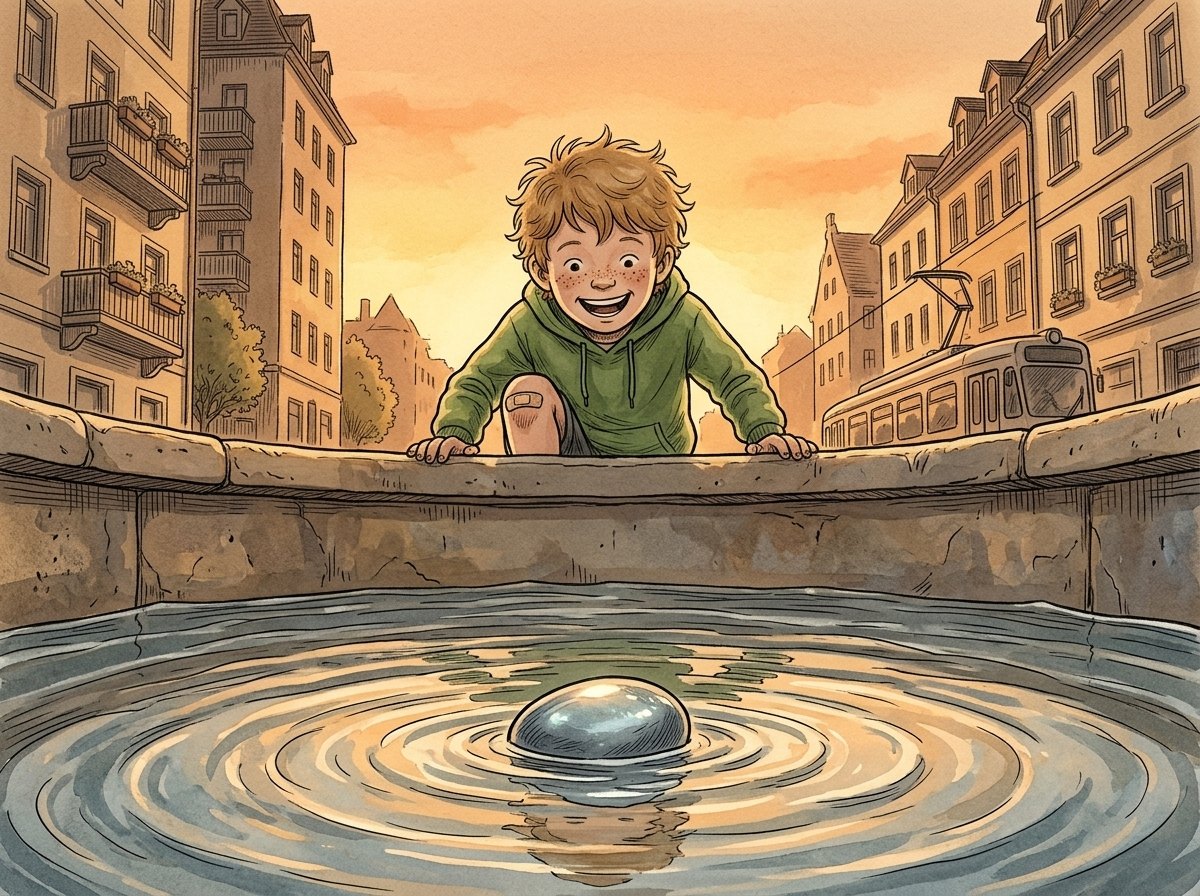
He crept like a snail to a well in a field, and there he thought that he would rest and refresh himself with a cool draught of water, but in order that he might not injure the stones in sitting down, he laid them carefully by his side on the edge of the well. Then he sat down on it, and was to stoop and drink, when he made a slip, pushed against the stones, and both of them fell into the water. When Hans saw them with his own eyes sinking to the bottom, he jumped for joy, and then knelt down, and with tears in his eyes thanked God for having shown him this favour also, and delivered him in so good a way, and without his having any need to reproach himself, from those heavy stones which had been the only things that troubled him.
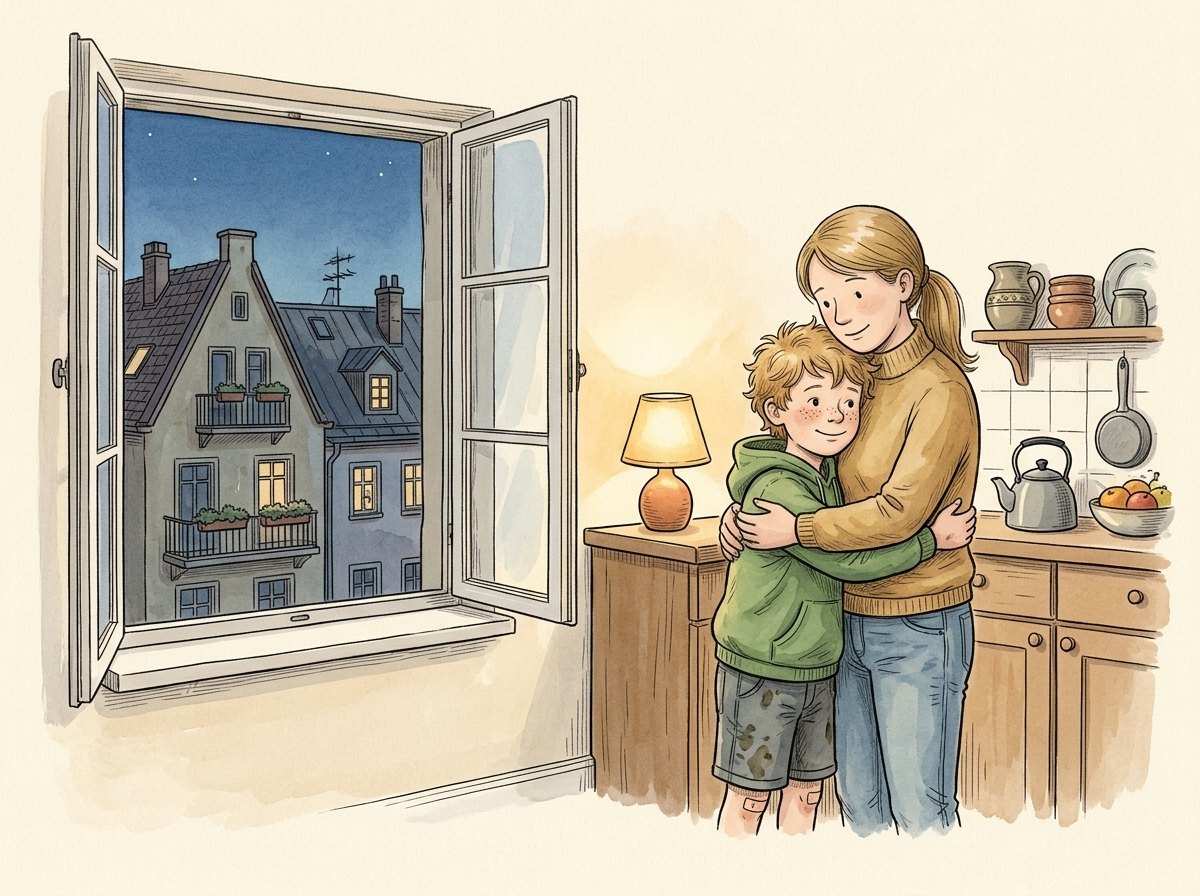
“There is no man under the sun so fortunate as I,” he cried out. With a light heart and free from every burden he now ran on until he was with his mother at home.