A fairy tale by the Brothers Grimm

The Wolf and the Seven Little Goats

age 4+ · 5 min read

Read in two languages:

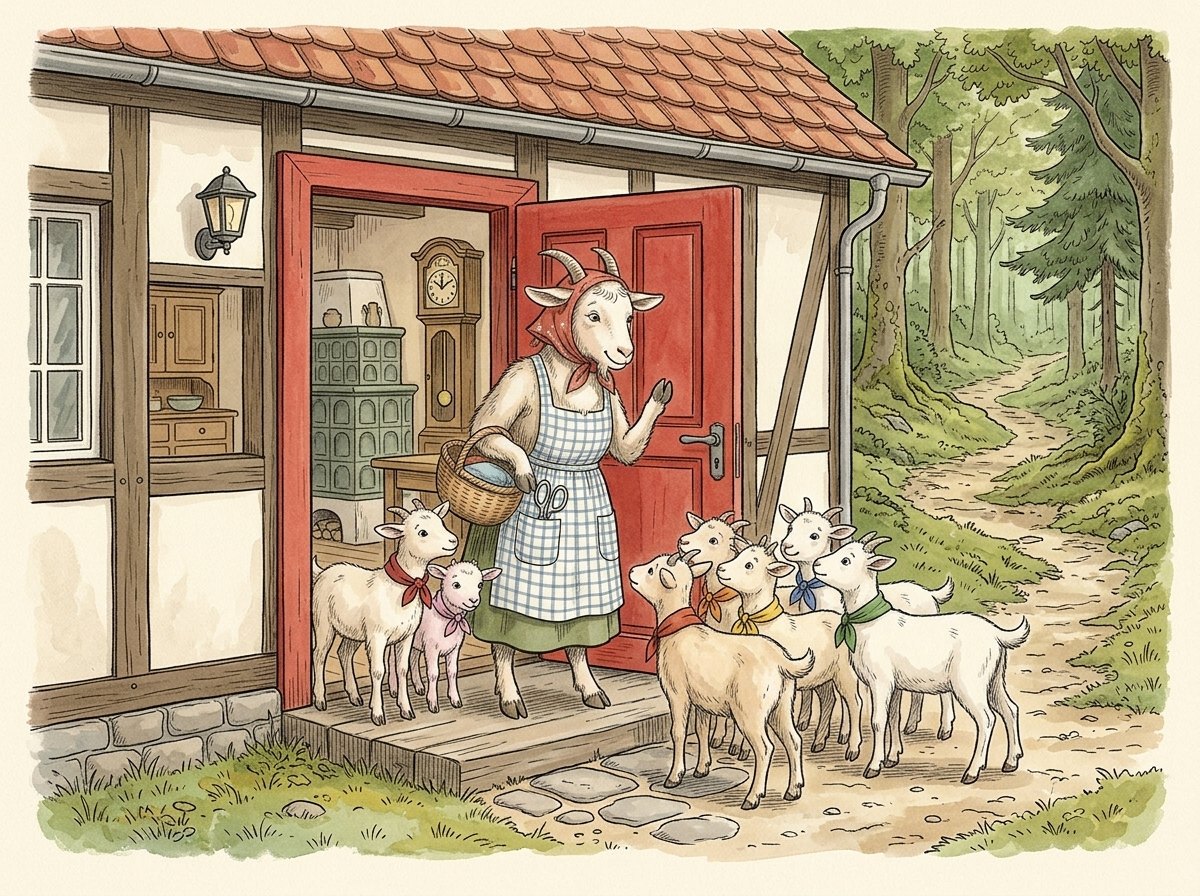
Once upon a time there was an old mother goat who had seven little goats. They lived in a cozy little house at the edge of the forest. Their mother loved them the way every mother loves her children. One day she wanted to go into the forest to fetch some food. She called out, “Be on your guard against the wolf! Don’t open the door to anyone. You will know him by his rough voice and his black feet.” “We’ll be careful, dear Mother!” promised the little goats.
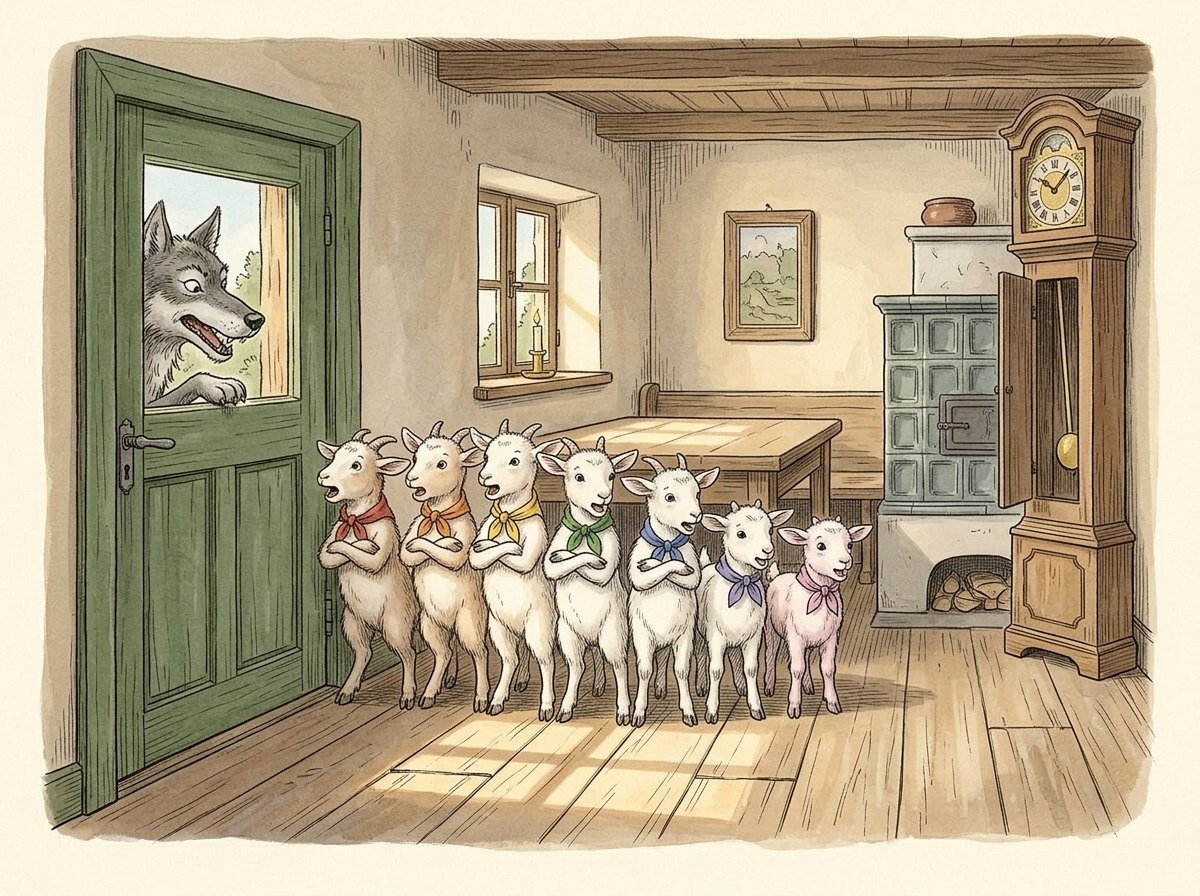
It wasn’t long before someone knocked at the door. Knock, knock, knock! “Open the door, dear children, your mother is here!” But the voice was rough and growly. The little goats looked at one another. Then they all called out together, “We will not open the door! You are not our mother! Our mother has a soft, sweet voice. You are the wolf!”

Together: Shout it out loud together: “We will not open the door! You are not our mother!”
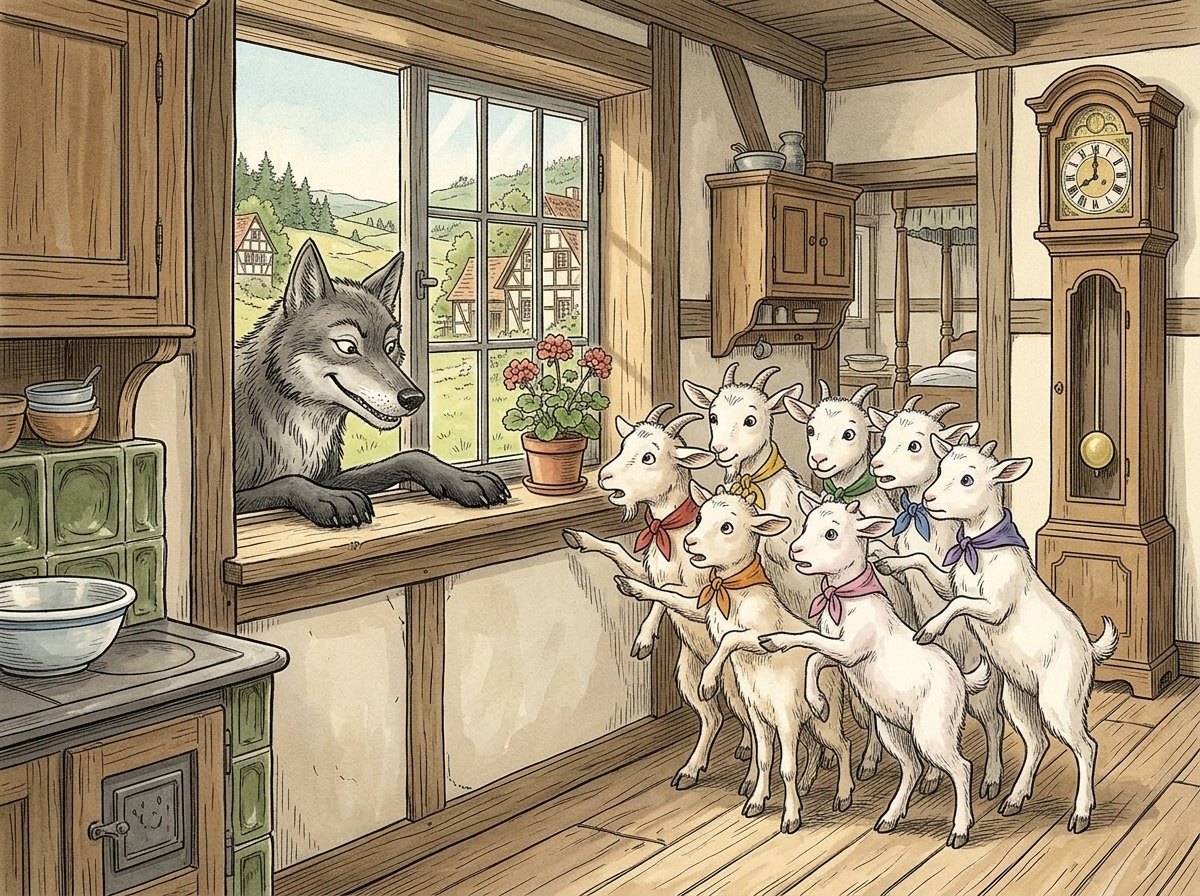
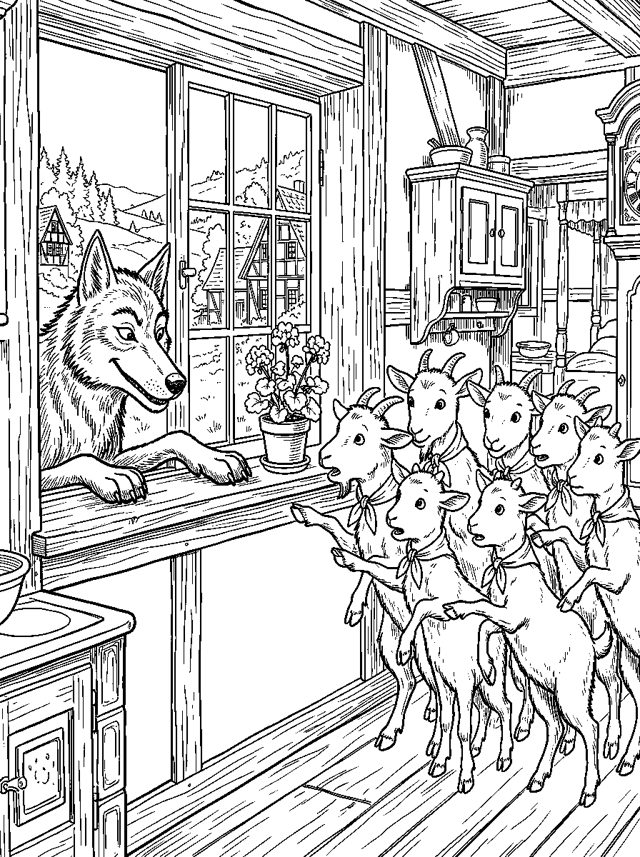
The Wolf crept away. He bought himself a big lump of chalk and ate it all up. Crunch, crunch, yuck! It made his voice soft and gentle. Again he knocked. “Open the door, dear children, your mother is here!” he sang sweetly. But as he spoke, he laid his black paw on the windowsill. The little goats saw it at once. “We will not open the door! You are not our mother! Our mother doesn’t have black feet.”

Together: Say it in a very soft, sweet wolf voice: “Open the door, dear children!”
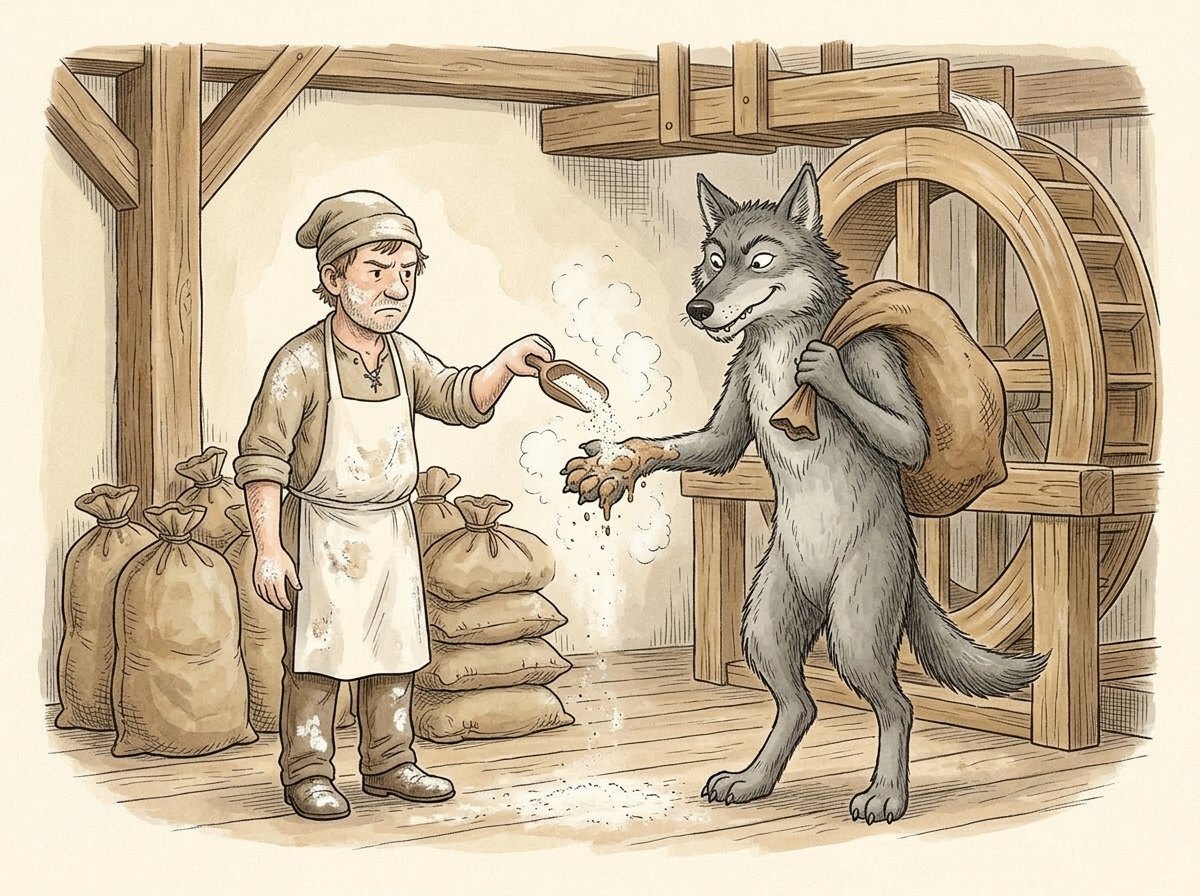
So the Wolf ran to the baker. “Rub some dough on my paw!” The baker did. Then he ran to the miller. “Sprinkle white flour on it!” The miller grumbled, but he dusted the paw snow-white. For the third time, the Wolf knocked. His voice was soft, and his paw was white. This time the little goats didn’t shout. “It’s our mother!” they cheered. And they opened the door.
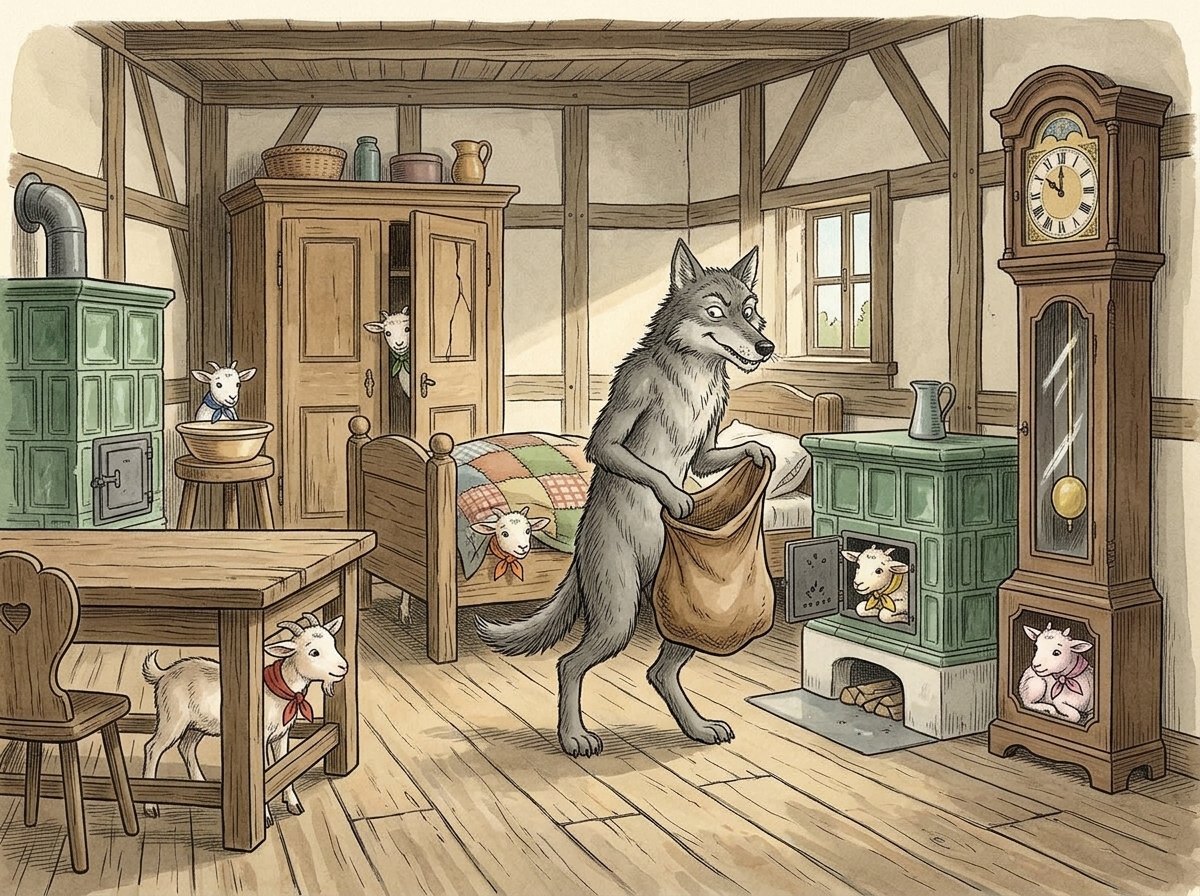
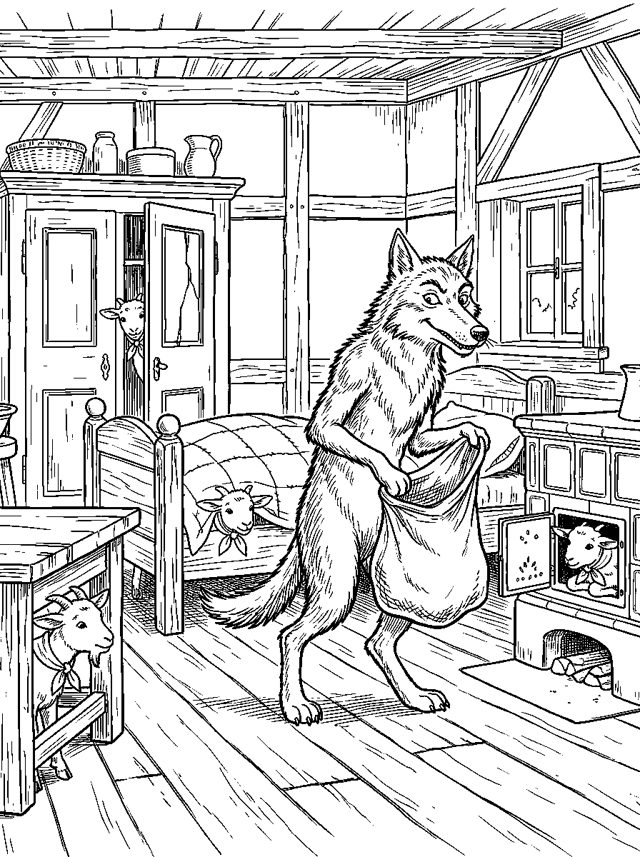
In came the Wolf! The little goats ran to hide. One under the table, one into the bed, one into the cold stove. One into the kitchen, one into the cupboard, one under the washbowl. The youngest slipped into the case of the big clock. The Wolf found six of them and put them in his big sack. Only the youngest he could not find. Then he trotted off to the meadow, lay down under a tree, and snored. Snorrr, snorrr!

Together: Count along on your fingers: Where are the seven little goats hiding?
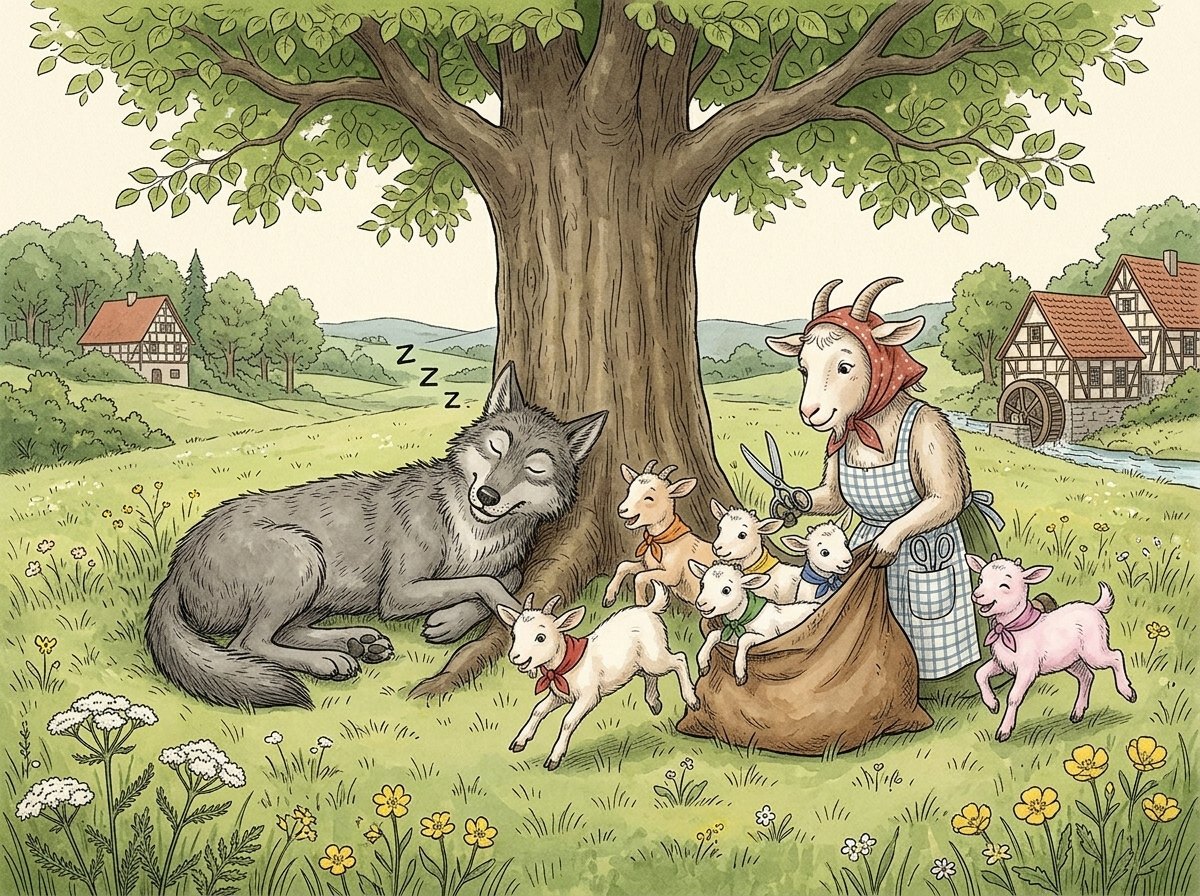
Soon Mother Goat came home. The door stood wide open. The chairs were knocked over. She called her children, one after another. Only one small voice answered: “Dear Mother, I am in the clock case!” Together they ran to the meadow. There lay the Wolf, snoring. Beside him, the sack was wriggling. Snip, snip! Mother Goat cut the sack open with her scissors. Out hopped all six, safe and sound.
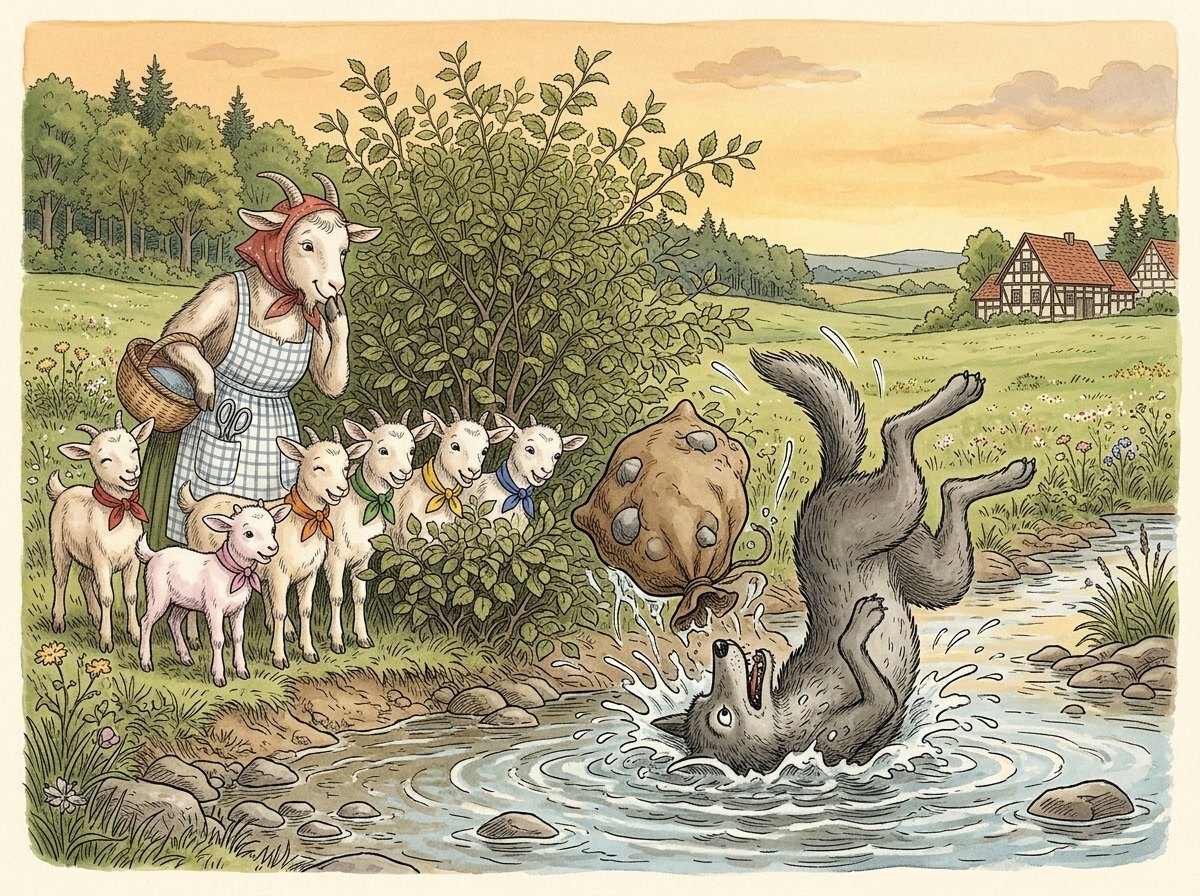
“Now fetch some big stones!” whispered Mother Goat. The little goats dragged heavy stones into the sack. Mother sewed it up quickly. The Wolf woke up and swung the heavy sack onto his back. He grumbled, “What rumbles and tumbles against my poor bones? I thought it was six kids, but it’s nothing but stones!” At the brook, he bent down to drink. The heavy sack tipped him over. Splash! Dripping wet, he ran off into the forest and never came back.
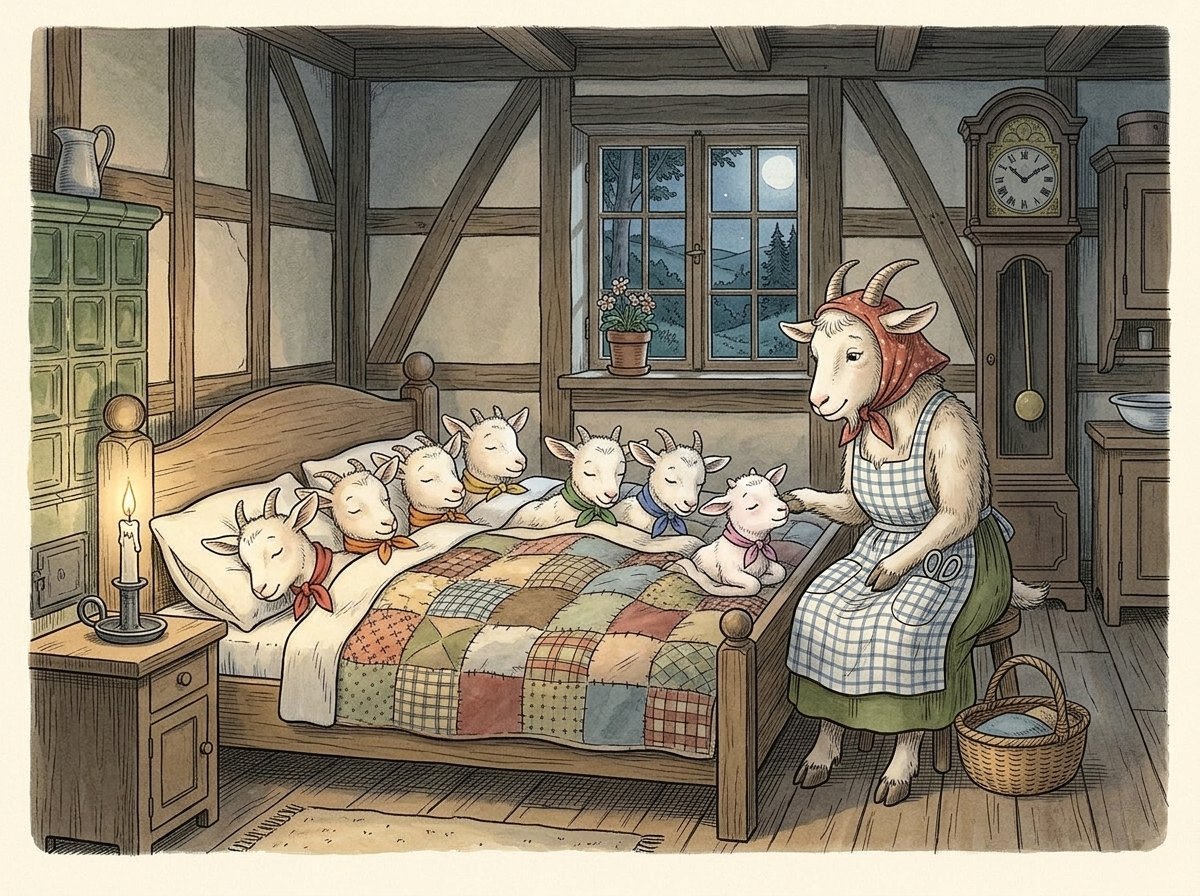
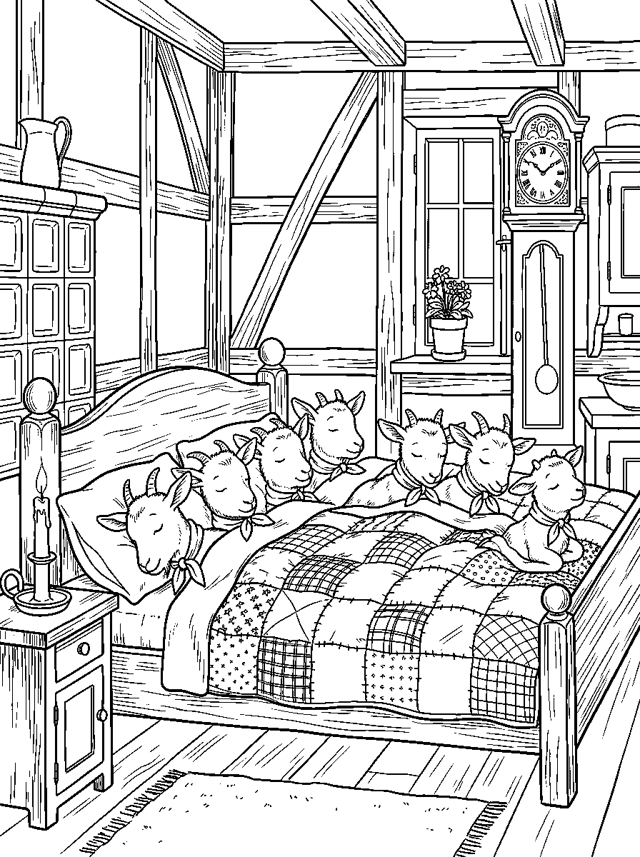
The seven little goats danced across the meadow with their mother. “The wolf is gone! The wolf is gone!” That evening, everyone lay in bed. Mother Goat counted softly: one, two, three, four, five, six, seven. All of them were safe and warm at home. She gave each one a kiss on the nose. Outside, the forest rustled. Inside, the big clock ticked very softly. Tick, tock, tick, tock.
And now… time to sleep

Sleep tight, my little goat. The door is shut, the clock ticks softly, and no one will take you from your warm, cozy bed.

Read the original text: „The Wolf and the Seven Little Kids“

The tale as the Brothers Grimm published it, in Margaret Hunt's classic English translation of 1884, unabridged. Note: in places the original is much harsher than our bedtime version.

There was once upon a time an old goat who had seven little kids, and loved them with all the love of a mother for her children. One day she wanted to go into the forest and fetch some food. So she called all seven to her and said, “Dear children, I have to go into the forest, be on your guard against the wolf; if he come in, he will devour you all—skin, hair, and all. The wretch often disguises himself, but you will know him at once by his rough voice and his black feet.” The kids said, “Dear mother, we will take good care of ourselves; you may go away without any anxiety.” Then the old one bleated, and went on her way with an easy mind.

It was not long before some one knocked at the house-door and called, “Open the door, dear children; your mother is here, and has brought something back with her for each of you.” But the little kids knew that it was the wolf, by the rough voice; “We will not open the door,” cried they, “thou art not our mother. She has a soft, pleasant voice, but thy voice is rough; thou art the wolf!” Then the wolf went away to a shopkeeper and bought himself a great lump of chalk, ate this and made his voice soft with it. The he came back, knocked at the door of the house, and cried, “Open the door, dear children, your mother is here and has brought something back with her for each of you.” But the wolf had laid his black paws against the window, and the children saw them and cried, “We will not open the door, our mother has not black feet like thee; thou art the wolf.” Then the wolf ran to a baker and said, “I have hurt my feet, rub some dough over them for me.” And when the baker had rubbed his feet over, he ran to the miller and said, “Strew some white meal over my feet for me.” The miller thought to himself, “The wolf wants to deceive someone,” and refused; but the wolf said, “If thou wilt not do it, I will devour thee.” Then the miller was afraid, and made his paws white for him. Truly men are like that.

So now the wretch went for the third time to the house-door, knocked at it and said, “Open the door for me, children, your dear little mother has come home, and has brought every one of you something back from the forest with her.” The little kids cried, “First show us thy paws that we may know if thou art our dear little mother.” Then he put his paws in through the window, and when the kids saw that they were white, they believed that all he said was true, and opened the door. But who should come in but the wolf! They were terrified and wanted to hide themselves. One sprang under the table, the second into the bed, the third into the stove, the fourth into the kitchen, the fifth into the cupboard, the sixth under the washing-bowl, and the seventh into the clock-case. But the wolf found them all, and used no great ceremony; one after the other he swallowed them down his throat. The youngest, who was in the clock-case, was the only one he did not find. When the wolf had satisfied his appetite he took himself off, laid himself down under a tree in the green meadow outside, and began to sleep. Soon afterwards the old goat came home again from the forest. Ah! What a sight she saw there! The house-door stood wide open. The table, chairs, and benches were thrown down, the washing-bowl lay broken to pieces, and the quilts and pillows were pulled off the bed. She sought her children, but they were nowhere to be found. She called them one after another by name, but no one answered. At last, when she came to the youngest, a soft voice cried, “Dear mother, I am in the clock-case.” She took the kid out, and it told her that the wolf had come and had eaten all the others. Then you may imagine how she wept over her poor children.

At length in her grief she went out, and the youngest kid ran with her. When they came to the meadow, there lay the wolf by the tree and snored so loud that the branches shook. She looked at him on every side and saw that something was moving and struggling in his gorged belly. “Ah, heavens,” said she, “is it possible that my poor children whom he has swallowed down for his supper, can be still alive?” Then the kid had to run home and fetch scissors, and a needle and thread, and the goat cut open the monster’s stomach, and hardly had she make one cut, than one little kid thrust its head out, and when she cut farther, all six sprang out one after another, and were all still alive, and had suffered no injury whatever, for in his greediness the monster had swallowed them down whole. What rejoicing there was! They embraced their dear mother, and jumped like a sailor at his wedding. The mother, however, said, “Now go and look for some big stones, and we will fill the wicked beast’s stomach with them while he is still asleep.” Then the seven kids dragged the stones thither with all speed, and put as many of them into his stomach as they could get in; and the mother sewed him up again in the greatest haste, so that he was not aware of anything and never once stirred.

When the wolf at length had had his sleep out, he got on his legs, and as the stones in his stomach made him very thirsty, he wanted to go to a well to drink. But when he began to walk and move about, the stones in his stomach knocked against each other and rattled. Then cried he,

“What rumbles and tumbles Against my poor bones? I thought ’t was six kids, But it’s naught but big stones.”

And when he got to the well and stooped over the water and was just about to drink, the heavy stones made him fall in, and there was no help, but he had to drown miserably. When the seven kids saw that, they came running to the spot and cried aloud, “The wolf is dead! The wolf is dead!” and danced for joy round about the well with their mother.

Source: Brothers Grimm, Household Tales, translated by Margaret Hunt, London: George Bell 1884 — KHM 5

Coloring pages

The pictures from the tale as free coloring pages – simple for little ones, detailed for older kids. Print them or download the PDF.

For parents

This tale, “Der Wolf und die sieben Geißlein” (roughly: dare VOLF oont dee ZEE-ben GUYS-line), came to the Brothers Grimm from the Main River region of Germany, probably from the Hassenpflug family. It appeared as early as 1812 in the first volume of their Children’s and Household Tales, as number 5 (KHM 5). Later, an Alsatian version by August Stöber was woven in as well. To this day it is one of the very first fairy tales in many German-speaking families, and children shout the little goats’ line out loud. You will find the Grimms’ original German text, in its old spelling, below the story.

What we changed

In the Grimms’ version, the Wolf swallows the little goats, and at the end he drowns in a well. In our version, he carries them off in a sack, and at the end he only tumbles into a brook. That way the story stays exciting, but nobody gets hurt.

Retold by talino.kids after the Brothers Grimm's “The Wolf and the Seven Young Kids” (KHM 5), final edition of 1857. Wilhelm Grimm noted that it came “from the Main region”.

Art style inspired by the Grimm illustrations of Otto Ubbelohde (1907–1909) and Ludwig Richter. AI-generated illustrations.

Text: retold and checked with AI · Pictures: AI-generated

The versions in other languages are machine-translated and checked by AI. Corrections are very welcome.

Report a mistake or a cultural concern

A story of their own for your child

talino.kids makes illustrated bedtime stories with your child as the hero – in English or German, optionally with a few words of a second language. Your first story is free.

Create a Free Story ✨

More tales by the Brothers Grimm